Co-op Shares vs Condos: What’s the Difference?
Co-op Shares vs Condos: What’s the Differences
“The strength of a community is measured by the compassion of its members.”
—Coretta Scott King
Introduction
If you’re exploring homeownership for the first time, you’ve probably come across two options that seem similar on the surface—but are actually very different:
Housing cooperatives (co-ops)
Condominiums (condos)
Both can be found in apartment-style buildings. Both offer an alternative to renting. And both can provide a pathway to ownership.
But here’s the truth:
The way you own, the way you buy, and the way you live in a co-op versus a condo can be dramatically different.
So what’s the real difference between buying a co-op share and purchasing a condo?
Let’s break it down clearly.

The Biggest Difference: How You Own
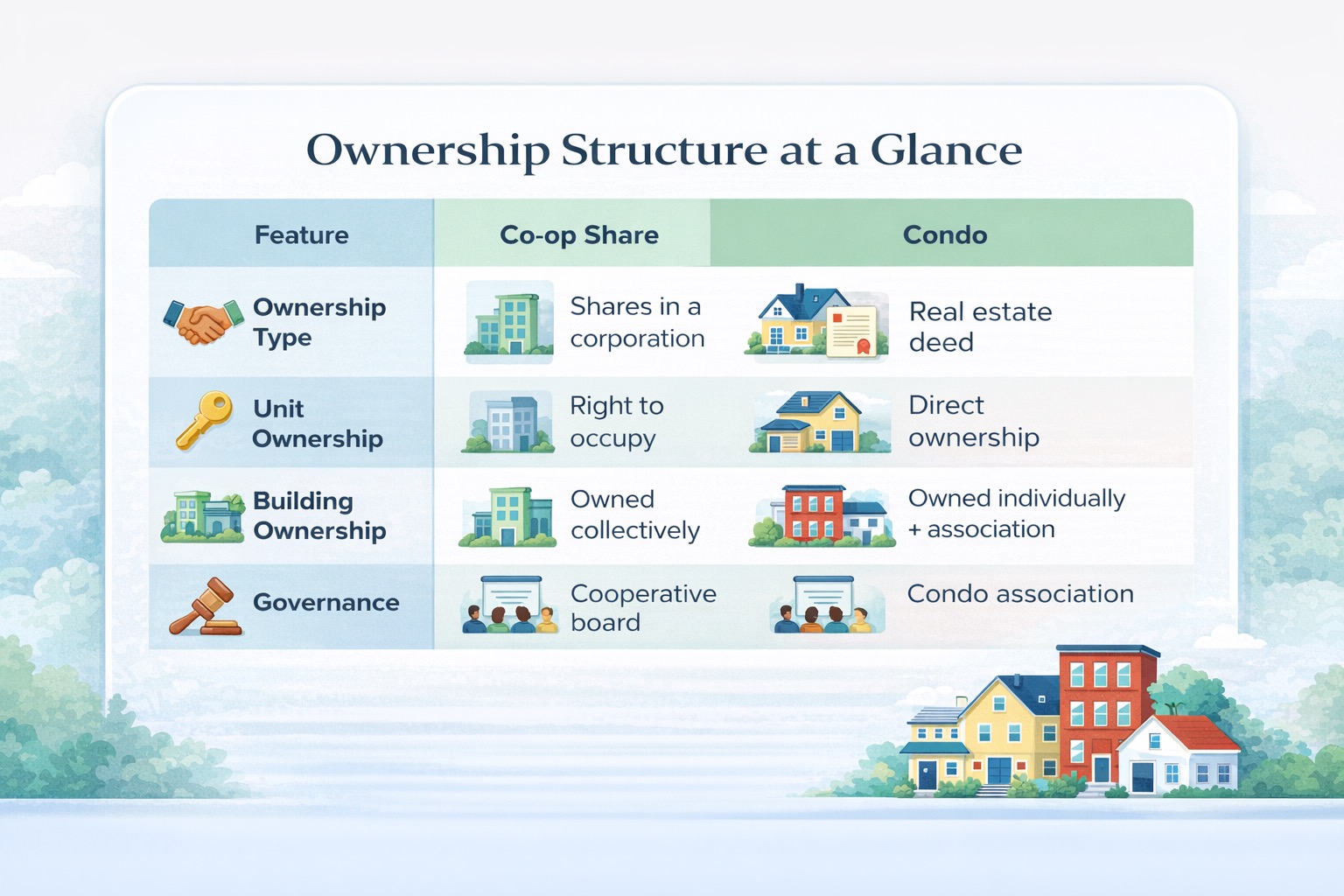
The biggest difference between co-op shares and condos ultimately comes down to how you own. The core distinction can be summarized by one simple question: do you own real estate—or do you own shares? This is the point where co-ops and condos separate into two entirely different ownership models, shaping everything from the buying process to the way residents experience community living.
In a Condo: You Own Property
When you buy a condominium, you are purchasing real estate, which means you receive the deed to your individual unit along with partial ownership of shared common areas such as hallways, elevators, and the lobby. As a condo owner, you are a direct property owner—similar to someone who owns a house. In many ways, a condo represents one of the most traditional forms of apartment-style real estate ownership.
That means you receive:
✅the deed to your individual unit
✅partial ownership of common areas like hallways, elevators, and the lobby
In a Co-op: You Own Shares
When you buy into a housing cooperative, the ownership structure is different from traditional real estate. Instead of purchasing a deed to a property, you purchase shares in the cooperative corporation, along with the legal right to live in a specific unit through a proprietary lease. You do not receive a deed; instead, you become a member-owner of the cooperative community. The co-op owns the building as a whole, and your shares represent your portion of ownership within that collective structure.
Instead of buying real estate, you purchase:
✅shares in the cooperative corporation
✅the legal right to live in a specific unit through a proprietary lease

Monthly Costs: Maintenance vs HOA
Both co-ops and condos include monthly payments, but they cover different expenses.
Co-op Monthly Maintenance Fees
Co-op residents pay a monthly maintenance fee that often includes:
Property taxes
Building mortgage (if applicable)
Professional Property Management
Repairs and building staff
Insurance
Reserve funds
These fees bundle major expenses into one predictable payment.
Condo HOA Fees
Condo owners pay HOA fees that typically cover:
Common area maintenance
Building amenities
Insurance for shared spaces
Reserve funds
However, condo owners usually pay separately for:
Property taxes
Mortgage payments
Utilities
The financial structure tends to be more divided than in co-ops.
The Buying Process: Co-ops Are More Selective
One of the most well-known differences between co-ops and condos is the approval process.
Buying a Condo
Buying a condo is usually a straightforward process. In most cases, the buyer makes an offer on the unit, secures financing through a lender, and then proceeds to closing once all paperwork is complete.
Unlike cooperative housing, condo purchases rarely involve interviews or approval from a board, making the transaction similar to buying a traditional home.
Buying a Co-op Share
Co-op purchases often involve more steps than a typical condo transaction. Buyers are usually required to complete a detailed application package, undergo a financial review, participate in a board interview, and receive official board approval before closing.
While this process can take longer, it helps protect the cooperative’s financial stability and ensures the community remains strong and well-managed.
Selling Your Home: Flexibility vs Oversight
Selling a Condo
Selling a condo is generally a flexible and independent process. Condo owners can typically list their unit on the open market, accept offers from interested buyers, and complete the sale with relatively few restrictions. In most cases, the transaction functions much like selling a traditional home, with the owner having full control over pricing, timing, and buyer selection.
Selling a Co-op Share
Selling a co-op share, however, is often a more structured process. Because cooperative housing is built on shared ownership and community governance, co-op shareholders may need to follow additional steps before a sale can be finalized. This can include receiving board approval for the prospective buyer, adhering to community rules on pricing or subletting, and complying with specific resale guidelines established by the cooperative.
While this structure may feel more regulated than selling a condo, it often plays an important role in protecting the long-term stability of the community, supporting affordability, and ensuring that the cooperative remains financially healthy for all residents.
Financing Differences
Financing is another major area where condos and co-ops differ. Although both involve purchasing a home-like living space, the type of ownership structure affects how buyers secure funding and what lenders require.
Condo Loans
Condo buyers typically use conventional mortgage loans, much like purchasing a single-family home. Because a condo is considered real estate and comes with a deed, the financing process is generally familiar, widely available, and supported by most traditional lenders.
Co-op Loans
Co-op financing can be slightly more specialized. Since buyers are purchasing shares in a corporation rather than real estate, lenders often approach these transactions differently. Co-op loans may involve lenders with specific experience in cooperative housing, particularly because the building itself may have an underlying mortgage and financial obligations.
In many cases, lenders also evaluate the overall financial health of the cooperative—not just the individual buyer—to ensure the community remains stable and well-managed.
However, it’s also important to note that in some cooperative communities, the buy-in cost for shares is significantly more affordable than traditional home prices. Because of this, many buyers are able to purchase their co-op share without needing a large loan at all, making cooperative housing an even more accessible path to ownership.
The good news is that whether financing is needed or not, co-op share purchases are common and supported in many markets, offering buyers flexibility and opportunity.
Community and Lifestyle
Ownership isn’t just financial—it’s cultural. The lifestyle in a co-op versus a condo can feel very different, because the structure of ownership shapes the way residents interact, participate, and build community.
Co-op Living
Cooperative living often emphasizes a deeper sense of connection and shared responsibility. Co-ops tend to foster strong community engagement, where residents are encouraged to participate in decision-making, attend meetings, and contribute to the wellbeing of the building. Because cooperative housing is collectively owned, shareholders are not just living in the space—they are actively invested in its long-term success.
This shared ownership model often leads to greater resident participation, stronger neighbor relationships, and long-term residency, creating a stable environment where people feel a genuine sense of belonging and pride in their community.
Condo Living
Condo living often provides a more independent homeownership experience. Condo owners typically have more autonomy over their unit, with fewer restrictions and less involvement in community governance or collective decision-making. While condo associations may still manage shared spaces, day-to-day participation is often minimal compared to cooperative housing.
This lifestyle can be especially appealing to buyers who value personal independence, prefer fewer approval processes, and want the flexibility of ownership with minimal oversight or community obligations.
Which Option Is Better?
The answer depends entirely on your goals. Both co-ops and condos offer meaningful paths to homeownership, but they serve different lifestyles, financial priorities, and community preferences.
If you are looking for affordability, long-term stability, and a strong sense of community involvement, a cooperative share may be the right fit. Co-ops often appeal to buyers who value shared responsibility, resident-driven decision-making, and a housing model designed to support long-term affordability.
On the other hand, if you prefer direct deed ownership, greater independence, and the flexibility to buy or sell with fewer restrictions, a condo may be a better match. Condos tend to attract buyers who want more autonomy and a traditional real estate structure.
Ultimately, the best option isn’t about which is universally better—it’s about which aligns with your personal vision of home, ownership, and community.
A Co-op May Be Best If You Want:
Affordability
Stability
Community-focused living
Shared responsibility
Long-term housing security
A Condo May Be Best If You Want:
Full deed ownership
Easier resale flexibility
Fewer approval steps
More independence
Both are valuable paths to ownership—it’s about what fits your lifestyle.

How CooperativeShares.com Makes Co-op Ownership Easier
At CooperativeShares.com, we specialize in one thing:
Helping people find, buy, and sell housing cooperative shares with clarity and confidence.
Our marketplace is built specifically for:
Co-op buyers
Cooperative boards
Management companies
Developers
Affordable homeownership advocates
If you’re ready to explore co-op living, we’re here to guide you every step of the way.
Final Thoughts
Co-ops and condos may look similar from the outside—but the ownership structure, buying process, and community experience are profoundly different.
Understanding these differences is the first step toward making the right housing decision.
Whether you choose a condo or a cooperative share, informed ownership starts with education—and CooperativeShares.com is here to help.
✅ Ready to Browse Co-op Shares for Sale?
Visit CooperativeShares.com and discover a smarter, community-driven way to own.


